
The rescue station garage
When miners got into trouble underground, it usually fell to their workmates to go in after them. In 1910 Cowdenbeath became the first place in Scotland with a dedicated mines rescue station.
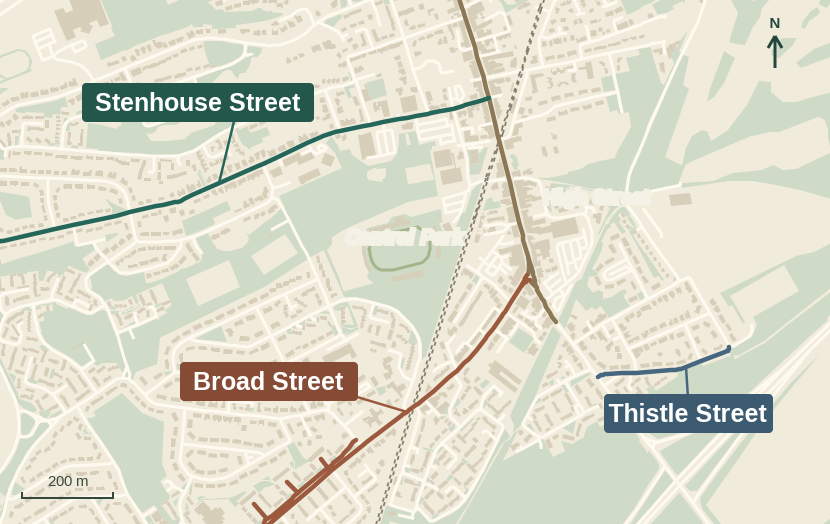
The University of St Andrews holds photographs of the Stenhouse Street crews. In one, seven men pose in the garage doorway with a practice dummy on a stretcher. Five are wearing breathing apparatus. In another, the name on the equipment boxes identifies the crew standing beside the ambulance as Cowdenbeath's.
From mining school to community hall
The Broad Street Centre began life as a gym. It belonged to the Fife Mining School, built on the site of Woodside House in 1936. When the school closed in 1976, Councillor Tom Dair and community worker Tom Bain helped save the gym from demolition.
The building went on to serve the town for nearly forty years. The hall has since come down, but the Broad Street Centre Legacy Group made a film with the people who used it.
Long before the gym, the mining school had just two rooms at Broad Street School. Joseph Parker studied in Edinburgh by day and taught miners in Cowdenbeath in the evenings. As principal, he pressed for more space. His own research was on mine ventilation. One resident remembered apprentices from the pits and the Central Workshops coming to Broad Street for their training.
Inside the Central Workshops
The Fife Coal Company opened the Central Workshops in 1924. Its private railway brought locomotives and wagons in for overhaul. The engineers also made equipment for the local pits and eventually supplied collieries as far away as the north of England.
One office worker remembered starting in the time office at sixteen in 1954. When she moved to accounts, she worked with punched cards. In June 2025 she and a former apprentice welder cut the ribbon on the cairn at the old works gates in Seco Place. The bricks came from the Workshops and the brass plaque once stood outside the canteen.
Learning a trade at the Workshops
One electrical apprentice came to the Workshops from Cowdenbeath Technical College, where his father had taught after working at the Aitken pit. In the electrical department the apprentice worked alongside a journeyman under the foreman.
Another apprentice came from the Moss Moran peat factory and went on to work at the Alice pit. A third, whose father ran a garage on Bridge Street, also learned his trade at the Workshops.