
At the railway bridge
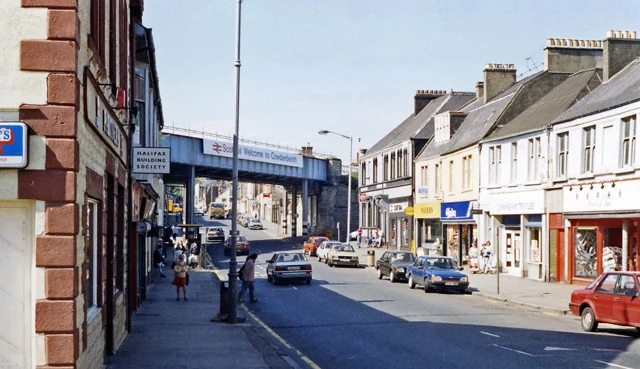
Stand on the High Street pavement south of the bridge and look towards the railway. The June 1988 photograph shows this approach with the station on the right. A Halifax sign hangs over the pavement on the left. Across the road, the shop windows run almost to the bridge.
To take the view again, put the bridge and the row of shops in the same frame. In the old photograph the chimney pots make a line down the right-hand side. How many of those rooflines can you still pick out?
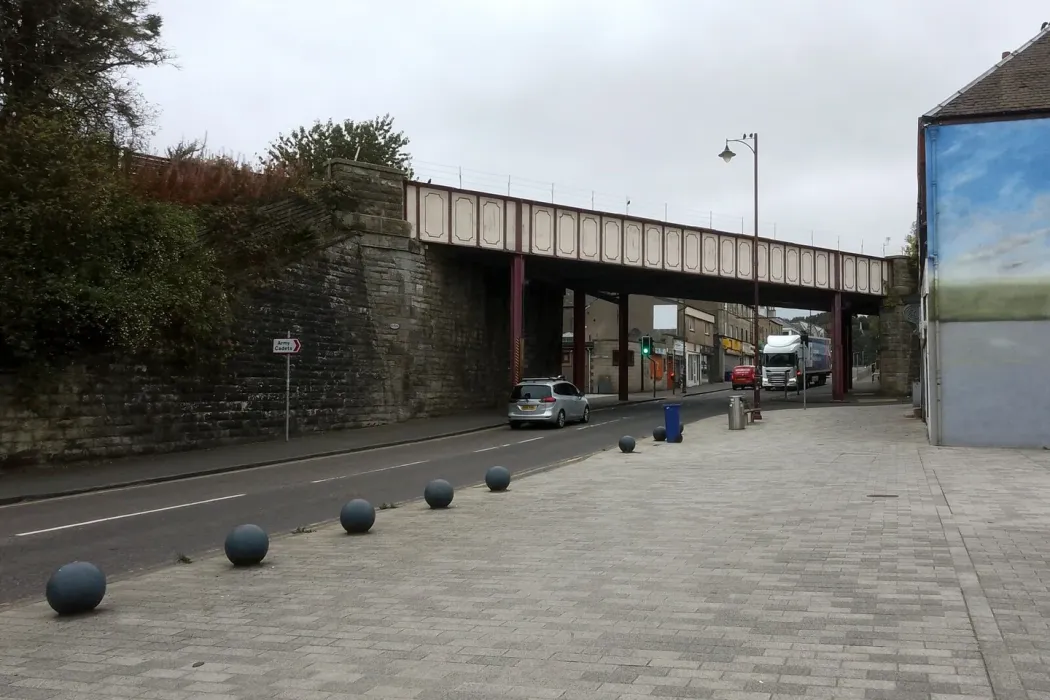
Which bridge is in the photograph?
The station beside the High Street shops opened in 1890. An 1848 timetable records the earlier station on the Dunfermline–Thornton line, and photographs survive of both stations. There was another crossing between Arthur Street and Park Avenue. A resident who played there as a child remembers a green footbridge with a rope swing underneath.
Where was Sharps?
When J. & R. Sharp & Co. advertised in the 1941 burgh history, the station was the only landmark it gave for its High Street shop. Customers could buy hard-wearing moleskins, dungarees, children’s clothes and household goods. The firm counted thirty assistants between its Cowdenbeath and Kirkcaldy shops.
Macdonald’s trade directories put the draper on the High Street in 1936–37 and 1942–43. An undated listing gives two door numbers, 166 and 168. We still need a dated source to tie those numbers to the wartime shop.
Photograph 166 and 168 High Street
There are later records for both doors. Balloons @ Hallmark gave number 166 as its business address in 2019. BT’s 2026–27 Fife directory lists Altyre Models at 168.
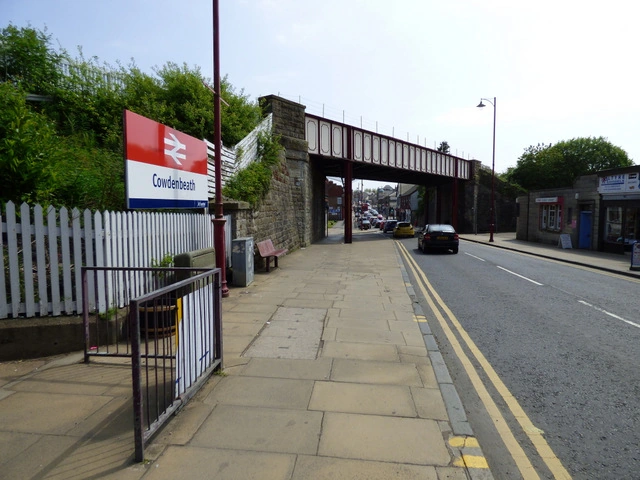
Walk under the bridge to the pavement by the station sign. Face back towards the bridge to match the 2016 photograph. For a second picture, turn towards the shops opposite and frame both doorways, their numbers and the roofline. Keep the date with the picture so it can be matched with an older view.
Tell us about a Sharps photograph or advert Record for 166 High Street Record for 168 High StreetThe clock on the Town House
For another High Street photograph, look for the domed clock above the entrance to the Town House. Architect Thomas Hyslop Ure drew it into his design in 1905. In an early colour view, a low wall separates the Town House from the shops on the left. Frame the clock and the neighbouring roofs together to see what has changed.