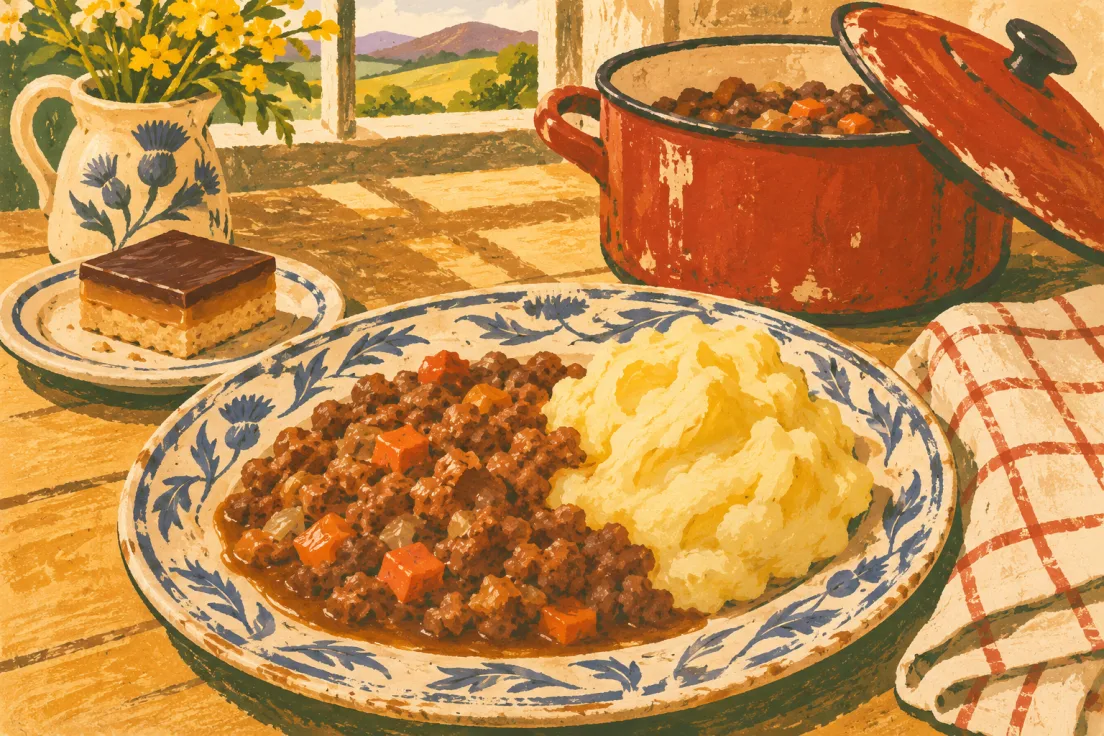
Mince and tatties for tea, a pot of lentil soup and millionaire’s shortbread for the biscuit tin.
Mince and tatties
Serves 4 · About 55 minutes
Put the tatties on once the mince is simmering. When you serve them, make a hollow in the mash for the gravy.
Ingredients
1 tbsp vegetable oil
500 g beef mince
1 onion and 2 carrots, finely diced
1 tbsp plain flour
400 ml beef stock
800 g floury potatoes
25 g butter and 2–3 tbsp milk
Salt and black pepper, to taste
Method
Heat the oil in a wide pan. Brown the mince in two batches, breaking it up with a spoon. Lift it onto a plate as each batch is ready.
Soften the onion and carrots in the same pan for 5 minutes. Return the beef, stir in the flour and cook for a minute. Add the stock a little at a time, stirring up the browned bits.
Bring to a gentle simmer. Cook for 25–30 minutes, stirring occasionally, until the carrots are soft, the mince is cooked through and the gravy coats the spoon. Add a splash of water if it gets too thick.
Meanwhile, peel the potatoes, cut them into even chunks and cover with cold water. Bring to the boil, then simmer for 15–20 minutes until tender. Drain, let the steam escape for a minute and mash with the butter, adding the milk a spoonful at a time. Season and serve with the mince.
Lentil soup
Serves 4 · About 45 minutes
Red split lentils break down as they cook, and a floury potato thickens the broth. Fife Council’s collection includes plain lentil soup and a version with bacon. Fife Council’s recipes
Ingredients
200 g dried red split lentils
1 onion, chopped
2 carrots, diced small
1 medium floury potato, peeled and diced
15 g butter or 1 tbsp oil
1.2 litres vegetable stock
Black pepper, to taste
Method
Rinse the lentils in a sieve. Heat the butter or oil in a soup pot and soften the onion and carrots for 5 minutes.
Add the potato, lentils and stock. Bring to the boil. If the lentil packet specifies an initial boiling time, follow it before turning down the heat. Simmer until the lentils fall apart and the potato crushes easily. Allow about 25–30 minutes from the first boil.
As the soup cooks, stir the bottom of the pot occasionally. For a thicker soup, crush a few pieces of potato against the side. For a thinner one, add a little water. Taste and add black pepper.
Haggis, neeps and tatties
Serves 3 · Vegetables 30–40 minutes · Check the haggis packet for its cooking time
The neeps in this Burns supper are swede. Mash them with butter and black pepper and give them their own place beside the tatties. Burns supper traditions
Ingredients
1 shop-bought haggis, about 450 g
500 g swede, weighed after peeling
600 g potatoes, peeled
30 g butter, divided
2 tbsp milk
Salt and black pepper, to taste
Method
Check the cooking time on the haggis packet so you know when to start. Follow its instructions for the casing and cooking method.
Cut the swede into 2 cm cubes and the potatoes into slightly larger chunks. Put them in separate pans of cold, lightly salted water. Put the swede on first and the potatoes about 5 minutes later. Once each pan boils, simmer the swede for 20–30 minutes and the potatoes for 15–20 minutes. A fork should slip easily into both.
Drain both pans well. Mash the neeps with half the butter and some black pepper. Mash the tatties with the remaining butter and a little milk. Check the haggis is piping hot in the middle. Remove any inedible casing and serve with a spoonful of each mash.
Makes 16 squares · 20 cm square tin · About 50 minutes, plus cooling and at least 2 hours to set
Bayne’s lists millionaire’s shortbread in its bakery guide. Its Cowdenbeath shop is at 118 High Street. Bayne’s bakery guide (PDF)
Ingredients
Shortbread
120 g unsalted butter, softened
60 g caster sugar
180 g plain flour
Caramel
150 g unsalted butter
150 g dark brown soft sugar
397 g sweetened condensed milk
Topping
180 g milk or dark chocolate, chopped
Method
Heat the oven to 180°C (160°C fan). Line the tin with baking paper, leaving enough over two sides to lift the slab out. Beat the softened butter and caster sugar together, then work in the flour. Press the crumbly dough evenly into the tin and prick it with a fork.
Bake for 22–28 minutes, until the edges turn pale gold. Leave the base to cool in the tin.
For the caramel, gently heat the butter and brown sugar in a deep, heavy pan, stirring until smooth. Stir in the condensed milk and bring to a rapid boil. Cook for about a minute, stirring right across the bottom, until the caramel thickens and a spoon drawn through it briefly leaves a trail.
Pour the hot caramel over the biscuit. Let it cool, then chill until firm. Melt the chocolate in short bursts in the microwave, stirring between each burst. Spread over the caramel and leave to set. Lift the slab out. Once the chill is off the chocolate, cut it into four strips with a sharp knife, then cut each strip into four squares.
Makes 8 small Scotch pies · About 1 hour 20 minutes · Standard deep muffin tin
A peppery Scotch pie has a little pastry rim above the lid. Mutton is traditional. These small beef pies take their shape from a muffin tin. The Rowett Institute’s Scotch pie recipe (PDF)
Ingredients
250 g plain flour, plus extra for rolling
½ tsp fine salt for the pastry
90 g lard, plus a little for the tin
110 ml water
400 g beef mince, ideally 10–15% fat
20 g fine breadcrumbs
3 tbsp cold beef stock
½ tsp ground white pepper and a pinch of mace or nutmeg
Method
Heat the oven to 190°C (170°C fan). Grease eight muffin wells of about 100 ml each. Stir the salt into the flour. Heat the lard and water in a pan until the lard melts and the liquid just boils. Pour into the flour and mix with a wooden spoon.
When the dough is cool enough to handle but still warm, knead it briefly. Keep a quarter covered for the lids. Divide the rest into eight, roll to about 3 mm thick and ease each piece into a well. Press out creases and patch any cracks.
Mix the mince, crumbs, stock, pepper and spice. Divide between the cases, leaving space for the lids. Roll eight small lids from the reserved pastry. Dampen the edges, set the lids just below the rims, pinch to seal and make a small steam hole in each.
Bake for 30–40 minutes. The pastry should be golden and the filling steaming hot throughout. If using a clean probe, insert it through the vent of the largest pie and check the centre stays at 75°C or above for 30 seconds. Bake a little longer if needed. Rest in the tin for 5 minutes before lifting out.
Morning rolls with square sausage
Makes 2 rolls · About 15 minutes
A round morning roll, a square slice of Lorne and just enough sausage showing at the corners. Clentrie Farm near Auchtertool makes its own Lorne sausage. Lorne sausage from Clentrie Farm
Ingredients
2 fresh slices of Lorne sausage
2 Scottish morning rolls
A little oil for the pan
Butter, brown sauce or tomato sauce, as you like
Method
Warm a lightly oiled frying pan over a medium heat. Fry the slices, turning to brown both sides. Follow the cooking time and temperature on the packet. For the Clentrie Farm slices, check the centre reaches 80°C.
Split the rolls while the sausage cooks. Butter them if you like, tuck a hot slice inside each one and pass the sauce.
Steak bridies
Makes 4 · About 2½–3 hours, plus time to cool the filling
Stephens Bakery opened its Cowdenbeath High Street shop in 1991. Steak bridies are one of its specialities. For these homemade bridies, the braising steak cooks slowly before it goes into the pastry. Stephens Bakery’s Fife history
Ingredients
1 tbsp oil
350 g braising steak, cut into 1–1.5 cm pieces
1 small onion, finely chopped
1 tbsp plain flour, plus extra for rolling
250–300 ml beef stock
Black pepper and salt, to taste
500 g chilled puff pastry, in a block
1 beaten egg, for sealing and brushing
Method
Brown the beef in batches in the oil. Set aside, soften the onion in the same pan, then stir in the flour. Return the beef and add enough stock to just cover it, a splash at a time.
Cover and simmer very gently for about 1½–2 hours, or until a fork easily splits the beef. Add a little water if it starts to dry out. Simmer uncovered until the gravy coats the beef and stops pooling in the pan. Season, then spread the filling in a shallow dish to cool. Refrigerate within two hours and use it cold.
Heat the oven to 200°C (180°C fan). Roll out the pastry on a lightly floured surface to about 3 mm thick and cut four 18 cm rounds. Divide the cold beef between them, keeping it to one half and leaving a clear 1½ cm border.
Brush the edges with beaten egg, fold the pastry over and crimp the curved edges. Put the bridies on a lined baking tray, brush the tops with egg and cut a steam slit in each. Bake for 25–35 minutes, until well risen and golden and the filling is piping hot in the middle. Rest for 5 minutes before eating.